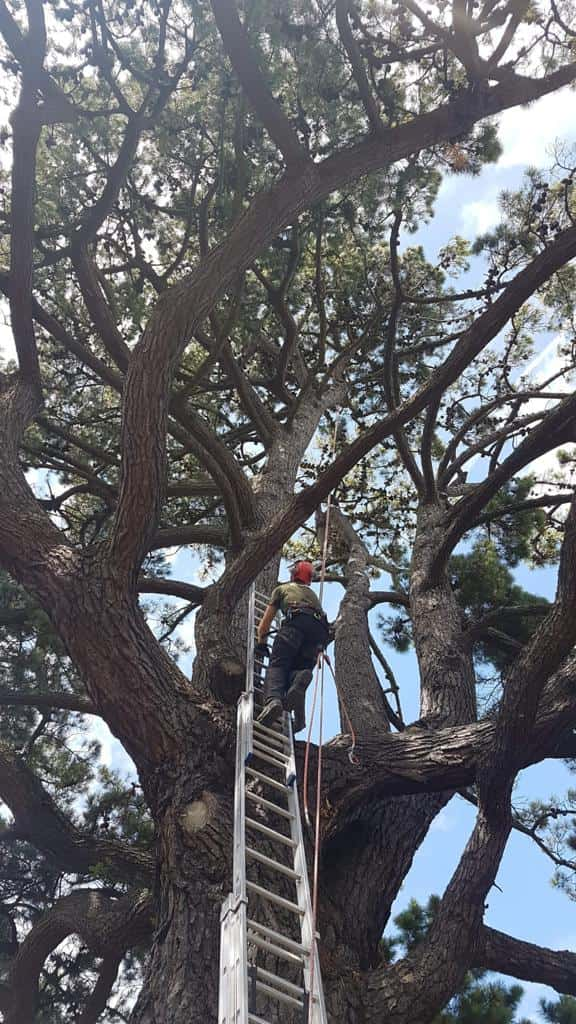
Trees rarely develop in perfectly symmetrical conditions. Available light, nearby structures, previous pruning, competing vegetation and natural growth habits can all influence the direction in which branches develop. Over time, this can leave a tree with noticeably heavier growth on one side, an uneven crown or individual branches that extend considerably further than the rest of the canopy.
Professional tree surgery can help manage unbalanced growth, but the objective is not simply to make a tree perfectly symmetrical. For property owners in Horley, Surrey, skilled tree management focuses on understanding why the imbalance has developed and deciding whether carefully planned pruning could improve the tree’s structure, appearance and suitability for its surroundings.
What Does Unbalanced Tree Growth Look Like?
An unbalanced tree may have a canopy that appears considerably fuller or heavier on one side.
Common examples include:
- Long branches extending predominantly in one direction
- Dense growth concentrated on one side of the crown
- Individual limbs becoming disproportionately large
- Uneven development following previous pruning
- Branches growing towards available light
- A canopy becoming unsuitable for the space around it
Some degree of unevenness is completely natural. Professional assessment is therefore important before deciding that pruning is necessary.
Why Do Trees Develop Unevenly?
Understanding the cause is the first step towards managing the problem correctly.
Competition for Light
Trees naturally grow towards available sunlight. If one side is shaded by surrounding features, branches may develop more strongly in the opposite direction.
Restricted Growing Space
Nearby buildings, garden features or other vegetation can influence how the canopy develops.
Previous Tree Work
Poorly planned or excessive pruning can leave a tree unbalanced and encourage vigorous regrowth in particular areas.
Natural Branch Development
Some trees simply develop asymmetrically because of their natural growth pattern. An uneven appearance does not automatically indicate that anything is wrong.
Branch Damage
If a significant limb has previously broken or been removed, the remaining canopy may become noticeably uneven as the tree continues growing.
Professional Assessment Comes Before Pruning
A skilled tree surgeon does not begin by simply removing branches from the larger side of the tree.
The tree should first be assessed for:
- Overall health
- Branch structure
- Previous pruning
- Dead or damaged growth
- Weight distribution
- Canopy density
- Position within the garden
- Likely future development
This allows the work to address genuine concerns without removing healthy branches unnecessarily.
Selective Pruning Can Improve Balance
Where intervention is appropriate, selective pruning can help manage individual branches that have become excessively long or dominant.
Rather than cutting everything back uniformly, suitable branches are selected according to their position and contribution to the canopy.
This approach can help create a more balanced appearance while retaining the tree’s natural character.
Crown Reduction Can Manage Excessive Spread
Where a substantial part of the canopy has become too large for its surroundings, crown reduction may be considered.
Professional crown reduction involves selectively shortening branches back to suitable growth points. The objective is to reduce overall dimensions without leaving abrupt cuts or an unnatural outline.
For an uneven tree, reduction may concentrate more heavily on particular parts of the canopy while still considering the structure of the tree as a whole.
Crown Thinning May Help With Dense Growth
Sometimes the problem is not excessive height or spread but unusually dense growth in certain areas.
Crown thinning involves selectively removing branches from within the canopy without substantially altering its overall dimensions.
Where suitable, this can:
- Reduce excessive density
- Improve light penetration
- Improve air movement through the crown
- Reduce the visual dominance of heavily congested areas
Careful selection is essential to avoid creating new areas of imbalance.
Overextended Branches Can Be Managed
A single long branch can sometimes make an otherwise well-proportioned tree appear significantly uneven.
Where appropriate, reducing an overextended limb can improve the relationship between that branch and the remainder of the canopy. It may also reduce excessive end weight on the limb.
The amount removed should be determined by the tree’s species, structure and condition rather than by appearance alone.
Correcting Poor Previous Pruning
Unbalanced growth can sometimes be the result of earlier tree work.
If branches have been removed indiscriminately from one part of the crown, the tree may respond with vigorous new growth. Correcting this situation may require a gradual management approach rather than another severe reduction.
Professional tree surgeons can assess how the tree has responded and determine which growth should be retained or selectively managed.
Why Cutting the Larger Side Back Heavily Is Not the Answer
When one side of a tree looks too large, heavily cutting that section may appear to be the obvious solution. In practice, this can create further problems.
Excessive pruning can:
- Remove too much healthy foliage
- Leave large pruning wounds
- Encourage vigorous regrowth
- Spoil the tree’s natural form
- Create a different imbalance
Good tree surgery aims for controlled improvement rather than an immediate artificial symmetry.
Future Growth Needs to Be Considered
Professional tree management is not only concerned with how the tree looks immediately after the work.
An experienced tree surgeon also considers how remaining branches are likely to develop. Appropriate pruning points can encourage a more manageable future canopy and reduce the likelihood of the same problem quickly returning.
For some trees, achieving the best result may require gradual management over time rather than extensive pruning in a single visit.
Maintaining the Character of the Tree
A perfectly symmetrical tree is not necessarily a healthier or more attractive tree.
Mature trees naturally develop individual forms influenced by their environment. Professional pruning should respect these characteristics wherever possible.
The objective is to address problematic growth while retaining:
- Healthy branches
- Natural proportions
- Characteristic shape
- Appropriate canopy density
This produces a much more sympathetic result than simply trying to force the tree into a predetermined outline.
Why Choose NS Tree Surgery Horley?
At NS Tree Surgery Horley, we provide professional tree surgery services throughout Horley, Surrey, including tree pruning, crown reduction and the management of overgrown or unbalanced trees. We assess each tree individually to understand why its growth has developed in a particular way before recommending appropriate work.
Our approach focuses on purposeful pruning and careful tree management, helping homeowners achieve a safer, more manageable and visually balanced landscape without unnecessary cutting.
Conclusion
Professional tree surgery can help manage unbalanced growth through carefully selected techniques such as pruning, crown reduction and crown thinning. However, the correct solution depends on why the uneven growth developed and whether it presents a genuine structural, practical or aesthetic concern.
Simply cutting heavily into the larger side of a tree can create further problems. A planned approach considers the entire canopy, the tree’s natural growth pattern and how it is likely to develop in the future.
For homeowners in Horley, Surrey, who have a tree that appears uneven, overextended or increasingly difficult to manage, NS Tree Surgery Horley can assess its condition and recommend appropriate tree surgery designed around the individual tree and its surroundings.
Call us on: 01293 225 592
Click here to find out more about NS Tree Surgery Horley
Click here to complete our contact form and see how we can help with your tree needs.